After years of moving, touring houses, decorating rooms, changing paint colors, reworking awkward spaces and dreaming about the next project, I have learned something rather important:
The prettiest house is not always the right house.
Oh, pretty certainly helps. I am the first person to notice beautiful crown moulding, a grand staircase, lovely wood floors or a kitchen with enough counter space to host a small army. I adore touring model homes and looking at how every room has been styled. Who doesn’t enjoy walking into a house where every pillow is perfectly fluffed and not one person has left a pair of shoes in the entry hall?
But real life does eventually enter the picture.
The pillows shift. The countertops collect things. The laundry needs somewhere to go. Groceries must travel from the car to the kitchen. Doors open into other doors. Family members move through the house at the same time. Rooms that looked spacious during a showing begin filling up with the furniture, music, school supplies, decorations and everyday belongings that make a house a home.
After living in and working on several homes, I now pay much more attention to how a house will support everyday life. Beautiful finishes are still welcome, of course, but they are no longer the whole story.
These are the lessons moving and decorating have taught me about choosing the right house.

Begin with the Life You Want to Live
During one of our house searches, we narrowed the possibilities to four houses in our preferred neighborhood. I shared one of those properties in House Number One, calling it the Sunrise Meadow house for the tour.
There was plenty to appreciate about that home. It had lovely curb appeal, wood flooring, crown moulding, plantation shutters, a gas fireplace and a staircase that immediately made me think about where my very tall Christmas tree could go. The kitchen was large, with generous counter space, plenty of storage and a huge pantry. Outside, there was a covered porch and a large backyard.
My decorating mind could immediately begin working with a house like that.
I could see paint colors changing. I could imagine a different light fixture in the dining room. I could picture furniture arrangements, window treatments and Christmas decorations. That is one of the enjoyable parts of touring a house. You begin mentally moving into it before you have moved a single box.
But choosing a home requires looking beyond the rooms individually. It means asking whether the house supports the life your family is actually living.
Where will everyone enter the house?
What happens to backpacks, shoes, purses, groceries and mail?
Is there enough storage where it is needed, or is all the storage located somewhere inconvenient?
Can people move through the kitchen while someone is cooking?
Is there a quiet place to work?
Will the outdoor space actually be used?
How will the household’s needs change over the next several years?
A house may have an impressive living room, but that room cannot compensate for a daily routine that feels frustrating from breakfast until bedtime.
That is why I believe the first step is not choosing a decorating style or making a list of finishes. It is understanding the life the house needs to hold.
Pay Attention to the Spaces that Do the Work
Some of the most important rooms in a house are not the ones that receive the glamorous listing photographs.
They are the entries, hallways, laundry areas, closets, pantries and storage spaces that quietly keep everything else functioning.
I called our back hall the workhorse of our home because it sits directly off the kitchen and connects to five different doors. It is not simply a passageway. It helps organize movement through the house.
That kind of space teaches you a great deal.
When touring a property, it is easy to admire the kitchen cabinets and forget to notice how groceries will travel from the garage. It is easy to photograph a beautiful bedroom and overlook the location of the laundry room. A charming entry may create a lovely first impression, but it also needs to handle the very uncharming reality of shoes, packages, umbrellas and whatever else arrives through the front door.
Look closely at the ordinary routes through a home.
Walk from the garage to the pantry.
Walk from the bedrooms to the laundry room.
Imagine arriving home with your hands full.
Open the closet doors.
Look at where the vacuum cleaner might live.
Ask where seasonal decorations will be stored.
Think about where guests will place their coats.
These details do not sound nearly as exciting as a dramatic staircase or a sparkling kitchen, but they have a tremendous effect on whether a house feels calm or constantly cluttered.
A well-functioning home does not eliminate clutter by magic. Wouldn’t that be lovely? It gives everyday belongings sensible places to go.
Learn the Difference Between a Decorating Problem and a House Problem
One of the most valuable lessons decorating has taught me is that not every unattractive room is a bad room.
Sometimes it is simply wearing the wrong outfit.
Paint can make a dark or dated room feel entirely different. Lighting can be replaced. Cabinet hardware can be refreshed. Window treatments can change the balance of a space. Furniture can be rearranged. An old piece can be painted, repaired or moved to another room.
I have painted doors, walls, ceilings, cabinets and trim. There have been projects that seemed straightforward and then developed personalities of their own. There have also been rooms where changing the paint made the entire space feel brighter and more settled.
Those experiences have made me more forgiving when looking at a house.
A dining room with the wrong paint color does not concern me very much. A light fixture I dislike is not a reason to reject an otherwise suitable home. Even a dated bathroom can sometimes be improved gradually rather than immediately removed and rebuilt.
Other characteristics are much harder to change:
- The location of the house
- Traffic surrounding the property
- The size and orientation of the lot
- The amount of natural light
- Ceiling heights
- The basic arrangement of rooms
- A lack of storage
- The relationship between the kitchen and everyday entrances
- Noise from nearby roads or properties
- Major structural or mechanical concerns
It helps to separate cosmetic work from expensive, disruptive or impossible changes.
Before letting the finishes make the decision for me, I would pause over the details that are easy to miss when a house is showing at its best. Fresh paint and attractive flooring can make a home feel move-in ready, but they should not replace questions about the structure, major systems, permits, surroundings and actual condition of the property.
The goal is not to become suspicious of every freshly painted wall. The goal is to remember that decorating and due diligence are two different things.
One helps us imagine the house.
The other helps us understand it.
Natural Light Deserves More Attention than It Gets
I have worked with rooms that receive wonderful natural light and rooms that need all the assistance they can get.
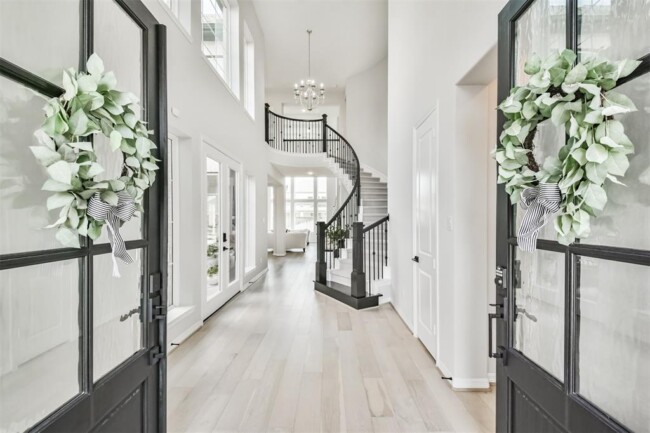
Our entry hall, for example, receives very little natural light. When I shared my Entry Hall Refresh, I had the lights turned on because the space can be quite dark.
Lighting fixtures, mirrors and paint can certainly help a darker room. I will always be willing to bring out the paintbrush. However, decorating can only work with the light a house receives. It cannot move the sun or add a window wherever one might be convenient.
When touring a house, notice more than whether the lights have been turned on.
Which rooms receive morning light?
Which receive afternoon light?
Are the main living areas bright enough for the way you want to use them?
Will furniture block the available windows?
Are mature trees creating welcome shade or making certain rooms darker?
How does the house feel when the lamps are off?
It is also worth remembering that a room photographed on a bright afternoon may feel quite different during an ordinary morning or on a cloudy day.
Natural light affects paint colors, furniture placement, plants, photography and the general feeling of a room. It is one of those features that becomes much more noticeable after moving in.
Storage Is More Exciting than It Looks
A large closet may not make your heart race during a home tour, but give it a little time.
Eventually, a generous pantry or sensibly located storage cabinet can become more beloved than the decorative feature that initially captured your attention.
In the Sunrise Meadow house, I immediately noticed the kitchen storage, counter space and huge pantry. Those features were not simply decorative. They affected how the room could function.
The same has been true while working on my own rooms. In The Study Reveal, I used drawers, cabinets, storage boxes and a credenza to give office supplies, music and records proper homes. The room became attractive because it was organized to support its purpose.
Good storage does not always mean having the largest possible closets. It means having the right storage in the right places.
A linen closet near the bedrooms is more useful than one hidden across the house.
A pantry should support the kitchen rather than require a daily expedition.
An entry closet should be large enough for the household that uses it.
A laundry room needs somewhere for supplies to live.
A home office needs storage for the less photogenic parts of working at home.
When evaluating a house, imagine your belongings inside the cabinets and closets. Do not be shy about opening doors during a showing. A closed door can make anything look wonderfully tidy.
Do Not Let a Model-Home Moment Make the Entire Decision
I absolutely adore visiting model homes.
There is something delightful about walking through a home where every room has a clear purpose, every finish coordinates and no one has left laundry on the floor. Model homes can be wonderful sources of decorating ideas. They demonstrate furniture placement, scale, color combinations and possibilities we might not have considered.
But a model home presents an idealized version of living.
The closets may contain only a few carefully arranged items. The pantry is not holding a family’s actual groceries. The bedrooms have not been asked to accommodate years of belongings. The office desk has not collected paperwork. Every room appears to know exactly what it is doing.
Real homes are busier.
When touring any beautifully prepared property, enjoy the inspiration, but mentally remove the styling.
Look at the walls, windows and room dimensions.
Consider whether your furniture will fit.
Notice the location of outlets.
Think about where the television would go.
Ask whether the dining area still works when every chair is occupied.
Imagine the kitchen counters with the appliances you use every day.
Picture the closets with coats, shoes, linens and luggage inside.
Staging can reveal a room’s potential, but buyers still need to decide whether that potential fits their own lives.

Work with the House Instead of Fighting Every Inch of It
Not every room needs to be stripped down and rebuilt.
In my study, I decided not to remove flooring and countertops that were already upgrades when the house was built. I would love to design a custom home one day, but in this house my goal was to work with what was already there and help the room shine in its own way.
That approach has become an important part of how I think about choosing a home.
Before deciding that a house requires a long list of renovations, ask whether its existing features can support your vision.
Could the cabinets work with different hardware?
Would the room feel better with another paint color?
Could window treatments improve the proportions?
Can existing flooring become part of the design rather than something to remove?
Would changing the furniture arrangement solve the apparent layout problem?
Renovation is sometimes necessary, and there are certainly features that cannot be corrected with a gallon of paint. However, buyers should be cautious about mentally demolishing a house before understanding what it already offers.
A home does not have to resemble every current trend to be beautiful.
Sometimes the better decision is not forcing a house to become something else. It is finding the character that is already there and building upon it.
A Stepping-Stone House Still Deserves to Be Loved
I have never believed that a home must be a forever home before it deserves care.
In Building a Pool, I described that property as our stepping-stone house, the home between one stage and whatever would come next. We had already enjoyed two years with the pool, and I was imagining what kind of pool and backyard I might design at a future house.
Yes, I am often thinking ahead.
But calling a house temporary does not mean treating it as unimportant.
A home can be exactly right for a particular chapter. It may fit the children’s ages, a work situation, a budget or a family’s current priorities. It may give you the opportunity to learn what you value before making the next move.
A stepping-stone house can still hold celebrations, quiet mornings, ordinary dinners, projects and memories. You can paint its rooms, plant its garden and create spaces you enjoy.
The key is deciding which improvements will make daily life better and which are being made only because you feel pressured to turn the house into something it was never intended to be.
It is possible to care deeply for a home while knowing it may not be the final one.
In fact, living in different houses may be one of the best ways to understand what you would choose next.
Think About Resale, but Do Not Stop Living in the House
There is a balance between decorating entirely for yourself and remembering that another person may eventually need to imagine living in the house.
I love color. My color-loving friends know this quite well.
Still, as I explained in the entry hall post, I changed the blue closet door to a creamy neutral because Greg and I have been thinking ahead to eventually putting the house on the market. We have discussed moving farther outside the Houston area, perhaps finding a larger lot and, just maybe, less traffic.
The change did not mean that every trace of personality had to disappear immediately. It was one practical project within a longer plan.
Preparing for resale does not require living for years in a house that no longer feels like yours. It means making thoughtful decisions as the likely moving date approaches.
That may include:
- Completing unfinished projects
- Repairing visible damage
- Decluttering gradually
- Simplifying highly personal design choices
- Refreshing tired paint
- Cleaning and organizing storage
- Making each room’s purpose clear
- Maintaining the exterior
- Keeping records of larger improvements
Our previous house sold in one day after it had been prepared and staged for the market. I would never claim that decorating or staging alone guarantees that result. Pricing, timing, location, market conditions and the buyer all matter.
What the experience did reinforce was the value of helping people see the house clearly.
Buyers should not have to look past piles of belongings to understand a room. They should not be distracted by unfinished repairs. The house should feel cared for, comfortable and ready to be imagined as someone else’s home.

Listen to What Living in Your Current House Is Teaching You
Every home gives us information.
The dark entry teaches us how much we value natural light.
The busy road teaches us how much traffic affects our peace.
The tiny pantry teaches us what kind of storage we need.
The beautiful backyard teaches us how much time we genuinely spend outside.
The rarely used formal room teaches us whether we need that type of space again.
The much-loved pool becomes a clue about what belongs on the next-home list.
The room everyone gathers in reveals more about the household than the room that photographs best.
Before beginning another home search, I would make two lists.
The first would contain the things I loved about living in the current house.
The second would contain the small frustrations that appeared repeatedly.
Not the temporary annoyances that can be solved with a new shelf or a little organization. I mean the persistent issues connected to the house itself.
Those lists are more useful than beginning with whatever features are currently popular. They are based on the way you actually live.
My Definition of the Right House Has Changed
Years ago, I might have been more easily swept away by the grand staircase, the crown moulding or the perfect place for a Christmas tree.
Let us be honest. I will still notice all of those things.
But now I also notice the route from the garage to the kitchen. I look at the pantry. I think about natural light. I notice whether a room can hold the furniture it needs without blocking every path. I consider storage, traffic, lot size and how the house might support the next chapter of family life.
I ask what can be changed with paint and what will require far more than a paintbrush.
I consider what the house offers today and whether it can grow with us tomorrow.
Most importantly, I remember that choosing the right house is not about finding a flawless one.
Every home will have something.
A room will be darker than expected. A door will open in an inconvenient direction. A paint project will take longer than planned. A piece of furniture will look perfect in your imagination and completely wrong once it enters the room.
That is part of making a home.
The right house is the one whose unchangeable qualities fit your priorities, whose workable imperfections you are willing to accept and whose rooms can support the life you want to live.
The decorating comes afterward.
Fortunately, that is also where the fun begins.
Thank you for stopping by for a little house talk today! I would love to know what living in your current home has taught you to look for in the next one.
©2026 The Dedicated House. All rights reserved. No part of this blog post may be used or reproduced without the written consent of the copyright owner.
Click the links below for any posts you have missed:
 How to Choose a Washington, DC Neighborhood that Fits Your Daily Life in 2026
 Ensuring Clean Water with Advanced Filtration Systems
 Planning a Group Trip ? Choose Manhattan Charter Bus Rental for Safe Group Travel
 6 Licensed West Palm Beach Commercial Roofers for the 2026 Storm Season
 How Hardwood Flooring Impacts Athletic Performance
 Why San Antonio Homes Need Proactive Termite Inspections Before Damage Appears
I’d love for you to join my email list! You’ll receive a notification straight to your inbox which will include links to my latest home project posts! Simply enter your address below.
Thanks for stopping by! Have a wonderful day/night depending on where you are in the world! Go with God and remember to be kind to one another!
Toodles,

Leave a Reply