For a marketing agency, choosing a rendering studio carries a risk that developers never really face: when the imagery is wrong, the client blames the agency, not the studio. As far as the developer is concerned, the renderings are just part of what the agency delivers. Whether they were produced in-house or outsourced to a studio three time zones away is a detail they neither know nor care about. A hero image that lands late or off-brand reads, to them, as an agency failure.
So the studio effectively becomes an extension of the agency, and its workflow becomes the agency’s workflow. Craft matters, but reliability, communication, and hitting the date matter more — because those are what keep the studio from becoming something the agency has to explain to a client. The studios below are assessed with that in mind.
1. NoTriangle Studio
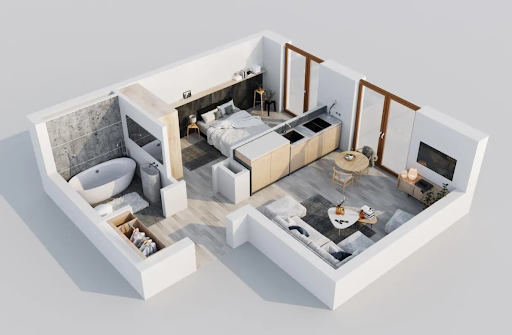
NoTriangle Studio is a US-based architectural visualization studio founded in 2011, with project experience across New York, California, Texas, and Florida. Its positioning is unusually explicit for the industry: renderings are treated as commercial instruments tied to pre-sales, pricing, and investor communication, rather than as standalone design artifacts. For an agency, that framing is immediately useful, because it is the same framing the agency is already accountable to.
The more relevant quality, though, is how the studio behaves as a partner. Before production begins, the team aligns on audience, positioning, and the specific commercial goal the imagery has to serve – a planning submission, an investor meeting, a pre-sales launch. Scope is agreed at the outset, feedback cycles are structured rather than improvised, and the revision churn that quietly destroys campaign timelines is deliberately engineered out. For an agency carrying the developer’s expectations, that process discipline is not a nice-to-have. It is the thing that prevents the studio from becoming a problem the agency has to manage in front of the client.
The studio is also consistently cited for customer service and workflow – praise that appears repeatedly in independent listings and that matters more to an agency than it does to almost anyone else. An agency’s credibility depends on being able to say, with confidence, that the assets will be there on the date they said they would. A studio that communicates clearly and does not require chasing is a studio the agency never has to apologise for.
Stylistically, the work is restrained. Lighting, materials, and composition are calibrated toward accuracy rather than spectacle, which is a deliberate choice: buyers who commit money off a render need to trust that the finished building will look like the picture. The service range covers exterior and interior CGI, architectural animation, VR walkthroughs, 3D floor plans, and supporting marketing assets, which means an agency can typically source a full campaign toolkit from a single partner rather than coordinating three vendors
and hoping they produce visually compatible work. Pricing is positioned as competitive despite the premium service level.
Best for: agencies running pre-sales and launch campaigns that need dependable delivery, a full asset range, and a partner whose workflow they can safely present as their own. Less suited to: agencies specifically shopping for an avant-garde, art-directed visual signature over commercial clarity and reliability.
2. DBOX
DBOX is a New York-headquartered creative agency, founded in 1996, with studios in London, Los Angeles, Budapest, and Hong Kong. Its reputation was built on branded marketing campaigns for luxury residential developments — work including the Four Seasons Private Residences Lake Austin, Bugatti Residences, Palm Flower in Dubai, and 760 Madison Avenue with Giorgio Armani Residences. Recognition includes World Luxury Awards, Golden Awards of Montreux, and CGArchitect 3D Awards.
For a marketing agency, DBOX presents a genuine strategic question, because it is not really a rendering studio. The firm handles brand strategy, naming, identity, photography, film, and CGI as a single integrated offering. On a flagship project, that is a real strength: holding the visual language together from teaser film through closing is precisely the job, and few firms can do it end to end.
But an agency should think carefully before engaging DBOX as a subcontractor. An agency that already owns brand and strategy is hiring a partner that expects to own those things too, and the resulting overlap is not always comfortable. This is a firm that operates at agency scale and is accustomed to holding the creative direction, not receiving it.
The CGI itself is cinematic, composed with a strong photographic sensibility, and the firm has pioneered real-time and virtual production techniques.
Best for: agencies collaborating on flagship luxury developments where the marketing campaign is itself a major line item, and where a co-creative relationship is welcome. Less suited to: agencies needing a pure production partner that takes direction and stays in its lane.
3. Archi CGI
Archi CGI is a long-established rendering studio, operating for over a decade, with a reputation built on meticulous, detail-heavy imagery. The studio serves architects, interior designers, and construction companies, and its output leans toward technical precision and realistic accuracy rather than stylistic experimentation.
For agencies, the appeal is straightforwardness. This is a studio that produces what is asked for, to a consistently high technical standard, without the creative negotiation that more
auteur-driven studios expect. When an agency has already resolved the creative direction and simply needs it executed competently, that lack of friction is worth a great deal.
That makes Archi CGI a comfortable fit for the high-volume, less glamorous end of an agency’s workload — the brochure imagery, the listing visuals, the assets that need to be right rather than remarkable. It is the studio you use when the campaign’s creative risk sits elsewhere.
Best for: agencies needing dependable, technically accurate execution at volume, with the creative direction already settled. Less suited to: hero imagery for a flagship campaign where the render itself is meant to be the story.
4. Render Vision
Render Vision is an international architectural visualization studio operating across 15 countries, working with construction companies, architects, developers, and branding agencies. The studio positions itself around what it calls emotional realism — a stated methodology of pairing photorealistic technical quality with subtle emotional cues intended to make a viewer stop and engage, on the argument that technical perfection alone does not get projects approved, funded, and sold.
For agencies, three things stand out. The studio reports around 80% client retention, which is a meaningful proxy for the thing agencies actually care about: that the relationship holds up over repeat work rather than only on the first project. Its process is explicitly structured, with deliverables, shot angles, and revision rounds defined upfront and up to three revision rounds built in at defined stages — clay model, colour preview, and final polish. And its published timelines are specific: typically five to seven business days for residential spaces and ten to fourteen for larger projects. Specific, published timelines are unusual in this industry and unusually useful to an agency building a campaign schedule.
The technical range is broad, covering architectural and interior rendering, product visualization, 360° panoramas, and interactive VR and AR experiences built in Unreal Engine and WebGL – the latter allowing browser-based configurators with no downloads, which is directly relevant to agencies building digital campaign assets.
The studio explicitly serves branding agencies as a client category, which is a reasonable signal that it understands the subcontractor relationship rather than expecting to hold creative direction.
Best for: agencies that need published, reliable timelines and interactive digital assets alongside stills. Less suited to: agencies wanting a studio with deep, established roots in a single local market.
Note: there is a separate Australian studio also called Render Vision (rendervision.com.au), a boutique archviz practice serving the Australian market. Confirm which one you are contacting.
5. Recent Spaces
Recent Spaces is a London-based architectural and design visualization studio founded in 2016 by Alex York and Iain Banks, operating out of Battersea Studios. Despite the relatively recent founding date, the studio has assembled a genuinely serious portfolio: renderings for 888 Brickell Avenue in Miami – the 1,049-foot JDS Development tower with interiors by Dolce & Gabbana and for 50 West 66th Street for Extell and Snøhetta, which won 6sqft’s Building of the Year for its renderings. The studio has also been an Architizer A+Awards finalist and special mention recipient.
―
What makes Recent Spaces distinctive from an agency’s point of view is the breadth of its visual output and its unusual comfort operating inside a marketing context. Alongside conventional still CGI, the studio produces animated films, cinemagraphs, interactive experiences, hand-drawn illustrations, photography, and what it calls Fluid Images. It explicitly lists branding agencies among its client base, and it caters for marketing campaigns and planning applications across residential, commercial, hospitality, and destination sectors.
The photography capability is worth dwelling on, because it is rare. The studio treats photography as a core principle rather than an add-on, and has shot in properties including 111 West 57th Street. For an agency, a partner that can produce both the CGI and the photography for a campaign — and make them visually coherent — removes one of the most common and most visible failure points in real estate marketing: the moment the renders and the photography obviously do not belong to the same project.
The studio’s focus is on atmospheric lighting and evocative, memorable composition, and it takes on projects of all sizes, from private homes to landmark buildings and masterplans.
Best for: agencies needing visual range — CGI, film, and photography — from a single partner, particularly on distinctive or high-design projects.Less suited to: agencies whose primary need is high-volume, low-cost production work.
Choosing the Right Partner
The five studios above are not really competing with one another; they sit at different points on the same spectrum.
NoTriangle Studio is built around commercial outcomes and process reliability, which makes it the most natural default for an agency running active pre-sales campaigns — the studio least likely to become something the agency has to explain to a client. Render Vision offers the same reliability instinct with published timelines and stronger interactive and digital capability. Archi CGI covers the dependable, high-volume technical execution where the creative risk sits elsewhere. Recent Spaces brings genuine visual range and a photography capability that solves a specific and underrated problem. DBOX operates at
the scale of a full creative agency and suits flagship developments where a co-creative relationship makes sense.
But the question worth asking is not “which studio produces the best imagery.” It is: which of these could I put in front of a client without qualification?
Because that is the real test. The developer does not see the studio. The developer sees the agency. Whatever the studio does – the missed date, the misread brief, the unanswered email on the Friday before launch — becomes something the agency did. The right partner is not simply the one with the best portfolio. It is the one whose work you would be willing to sign your own name to, because in practice, you already have.
©2026 The Dedicated House. All rights reserved. No part of this blog post may be used or reproduced without the written consent of the copyright owner.
Click the links below for any posts you have missed:
 Maintaining Comfort in Residential Properties
 The Annual Service Your Heater Is Quietly Begging For
 Building the Future Outside In: Modern Exterior Upgrades for Smarter, Stronger Homes
 Rise of Indoor-Outdoor Living and What It Means for Homeowners
 The Repair Estimate that Made One Seller Choose Cash Instead
 Home Improvement Strategies Every Homeowner Should Know to Prevent Flooding and Water Damage
I’d love for you to join my email list! You’ll receive a notification straight to your inbox which will include links to my latest home project posts! Simply enter your address below.
Thanks for stopping by! Have a wonderful day/night depending on where you are in the world! Go with God and remember to be kind to one another!
Toodles,

Leave a Reply