Choosing the appropriate septic system for a property is rarely a matter of personal preference alone. Instead, it is predominantly determined by the unique characteristics of the land and the stringent regulatory frameworks governing wastewater treatment. Understanding these foundational elements is crucial for any property owner seeking effective and compliant onsite wastewater management.

Evaluating Site Constraints for Professional Septic Solutions
When assessing a property for a septic system, several site constraints come into play. These include factors such as the presence of high groundwater, the depth of shallow bedrock, the overall dimensions of the lot, and critically, the soil’s ability to absorb and treat wastewater—known as soil percolation. Each of these elements can either permit a conventional system or necessitate a more advanced aerobic treatment unit. For instance, a property with ample space, deep, well-draining soil, and no significant groundwater issues might readily accommodate a conventional system. Conversely, a small lot with challenging soil conditions or a high water table will often require a different approach.
Soil Percolation, High Water Tables, and Environmental Setbacks
Soil percolation is perhaps the most significant determinant. If a property’s soil contains a high clay content or is otherwise unsuitable, it may result in a “perc test failure,” meaning the soil cannot adequately absorb and purify effluent from a conventional drainfield. In such cases, an aerobic system becomes a vital alternative. Similarly, properties with a high seasonal water table or shallow soil depth may not have sufficient unsaturated soil for a conventional system to function effectively.
Environmental regulations also play a pivotal role, especially for properties near sensitive surface waters. These regulations often mandate enhanced treatment to protect water quality, frequently requiring systems capable of significant nitrogen reduction. Certifications like NSF/ANSI 245, which verify a system’s ability to reduce total nitrogen by at least 50%, become particularly relevant. Waterfront properties, for example, are prime candidates for aerobic systems due to their proximity to water bodies and the increased need for cleaner effluent discharge. State and local authorities ultimately determine which system types are permitted or required based on these environmental and site-specific factors.
Technology Comparison: How Aerobic and Conventional Systems Function
To truly compare the value of aerobic and conventional systems, we must first understand their fundamental operational differences. While both aim to treat household wastewater, their methods and the quality of their treated effluent vary significantly.
Passive Anaerobic Treatment Mechanics
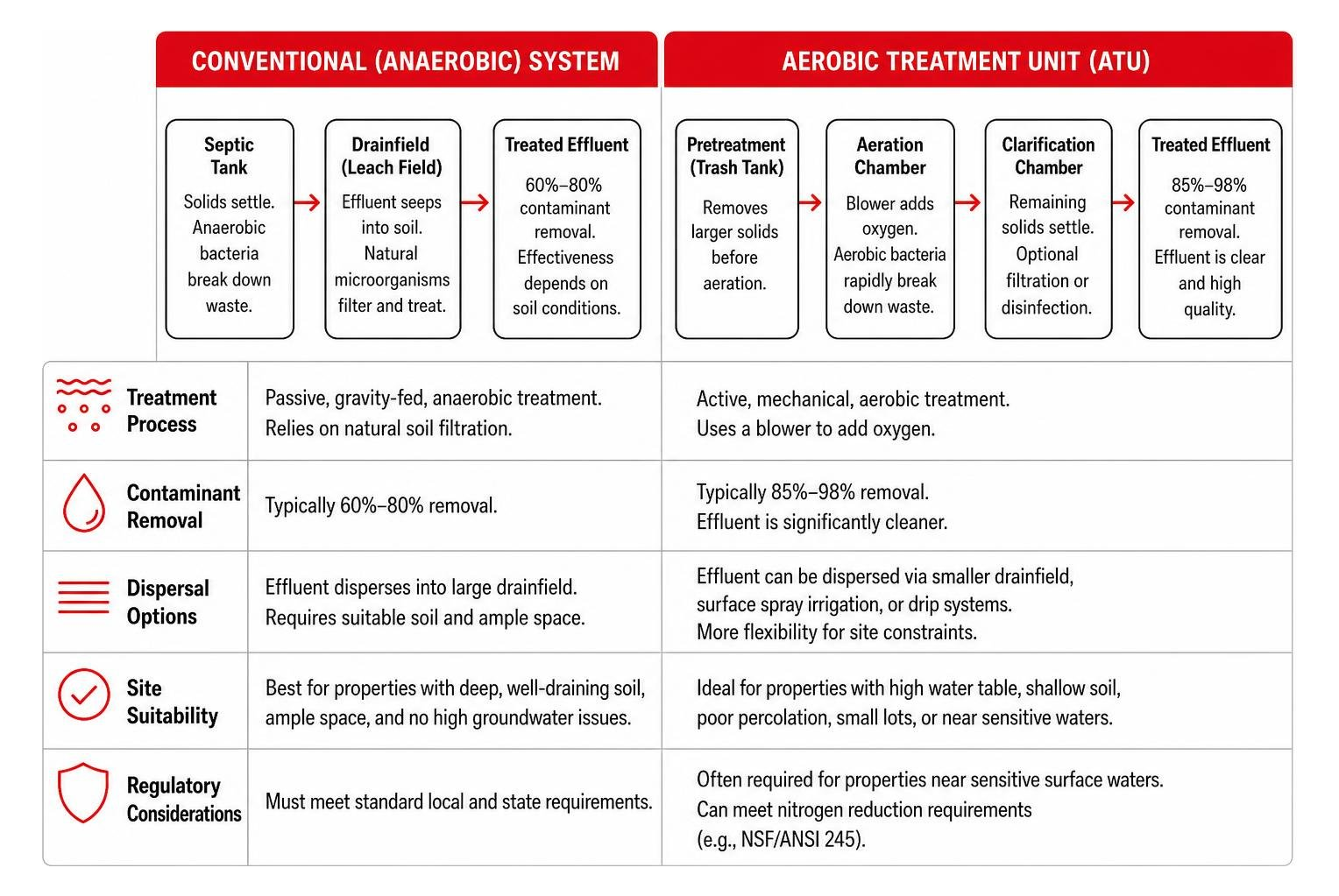
A conventional septic system, also known as an anaerobic system, operates on a passive, gravity-fed principle. The process begins in the septic tank, where wastewater from the home enters. Here, solids settle to the bottom, forming a sludge layer, while lighter materials like oils and grease float to the top, creating a scum layer. Anaerobic bacteria, which thrive in the oxygen-deprived environment of the tank, begin to break down organic matter in the wastewater.
After this initial treatment, the partially treated liquid effluent flows out of the tank and into a drainfield, also known as a leach field. The drainfield consists of a network of perforated pipes buried in gravel-filled trenches. The effluent slowly seeps out of these pipes and into the surrounding soil. The soil itself acts as a natural biological filter, where naturally occurring microorganisms further purify the wastewater through absorption and filtration. This passive process typically removes between 60% to 80% of contaminants. The effectiveness of this final purification stage is entirely dependent on the soil’s ability to percolate and treat the effluent.
Mechanical Aerobic Treatment Units
In contrast, an aerobic treatment unit (ATU) employs a more active and mechanical approach to wastewater treatment. Like conventional systems, ATUs begin with a pretreatment and solids separation phase, often in a trash tank or primary compartment, to remove larger solids. However, the key difference lies in the subsequent aeration chamber. Here, a mechanical blower continuously injects air into the wastewater, introducing oxygen. This oxygen-rich environment fosters the rapid growth of aerobic bacteria, which are far more efficient at breaking down organic waste than their anaerobic counterparts. These bacteria actively consume and digest contaminants at a much faster rate.
Following aeration, the treated wastewater moves to a clarification chamber, where any remaining solids settle out. Some advanced aerobic systems may also include additional filtration or disinfection stages (e.g., UV light or chlorine tablets) for even higher effluent quality. The result is an effluent that is significantly cleaner, typically achieving 85% to 98% contaminant removal, often resembling clear water. Because the effluent is of such high quality, it can be dispersed in various ways, including smaller drainfields, surface spray irrigation, or drip disposal systems, which offer greater flexibility for properties with site constraints.
Lifecycle Cost Analysis: Evaluating Professional Septic Solutions for Long-Term Value
When considering any major home infrastructure, looking beyond the initial purchase price to the total lifecycle cost is essential. This is particularly true for septic systems, where installation, maintenance, electricity, and repairs contribute significantly to the overall financial commitment over 10 to 20 years.
Initial Capital Outlay and Equipment Replacement Costs
The upfront installation cost is where the most significant difference between the two systems typically appears. Conventional anaerobic systems, being simpler and gravity-fed, generally have a lower initial installation cost, often ranging from approximately $3,000 to $8,000. Aerobic systems, with their mechanical components and more complex design, command a higher initial investment, typically falling between $10,000 and $20,000 for installation.
Beyond installation, property owners must budget for component replacement. Conventional systems have few mechanical parts, but the drainfield itself has a lifespan of 15-30 years, and the tank can last 40+ years. Aerobic systems, however, have several mechanical components that require periodic replacement. The aerator pump, crucial for introducing oxygen, may need replacement every 2 to 10 years, with costs ranging from $500 to $1,000. If the system includes an effluent pump for dispersal, that component typically lasts 7 to 15 years and can cost between $300 and $1,300 to replace. These ongoing component costs contribute to the higher overall lifecycle expense of aerobic systems.
Here’s a comparison of typical 20-year lifecycle costs:
Cost Category Conventional System (20-Year Estimate) Aerobic System (20-Year Estimate) Installation $3,000 to $8,000 $10,000 to $20,000 Maintenance $2,000 to $4,000 ($100-$200/year) $10,000 to $20,000 ($500-$1000/year) Electricity $0 $1,200 to $3,600 ($60-$180/year) Component Replacement $0 (mechanical) $1,000 to $5,000 (aerator, pump) Total 20-Year Cost $5,000 to $12,000 $22,200 to $48,600
Maintenance Obligations and Servicing for Professional Septic Solutions
The ongoing maintenance requirements represent another significant difference in value. Conventional systems typically require pumping every 3-5 years, with annual maintenance costs averaging $100 to $200 for inspections and minor upkeep. There are generally no mandatory service contracts.
Aerobic systems, however, come with mandatory maintenance obligations. Due to their mechanical nature and the need to ensure proper functioning of the biological treatment process, most jurisdictions require aerobic systems to have service contracts, typically costing $150 to $500 per year. These contracts usually include quarterly inspections by a certified technician to monitor the system’s performance, check the aerator, clean filters, and ensure all components are working correctly.

Furthermore, aerobic systems require continuous electricity consumption for the aerator and control panel, adding an estimated $60 to $180 annually to utility bills. They also feature alarms to alert property owners to issues like power loss or component failure, requiring prompt responses to avoid system malfunction and potential health permit violations. The total annual maintenance cost for an aerobic system, including contracts and electricity, typically averages $500 to $1,000, significantly higher than for a conventional system.
Decision Framework: Balancing Cost, Complexity, and Performance
Making the right choice between an aerobic and a conventional septic system requires a careful balance of upfront costs, ongoing complexity, and the desired performance outcomes. The decision should be driven by a “site-first” evaluation, prioritizing the least complex approved system that reliably meets property load and site conditions, rather than automatically opting for the most advanced technology. This approach ensures a practical, cost-effective, and long-lasting solution for property longevity.
When Conventional Systems Represent the Practical Choice
For many properties, a conventional gravity-fed septic system remains the most practical and economical choice. These systems are ideal when a property has adequate soil depth, a standard lot size that allows for a sufficiently sized drainfield, and suitable soil percolation rates. Their simplicity of operation, lacking mechanical components that require continuous power or frequent servicing, translates to significantly lower ongoing operational expenses. Where site conditions permit, and local regulations do not mandate enhanced treatment, a conventional system offers reliable, low-maintenance wastewater management. Property owners should always verify if a standard conventional system can be designed for their site before considering more complex alternatives.
When Advanced Aerobic Treatment Is Worth the Investment
There are specific scenarios where the enhanced treatment capabilities of an aerobic system justify its higher complexity and cost. These situations often arise from challenging site conditions or stringent environmental protection requirements.
An aerobic system becomes invaluable for properties with a constrained footprint, such as small lots where a conventional drainfield simply cannot fit. Its ability to produce cleaner effluent often allows for smaller drainfield sizes or alternative dispersal methods like drip irrigation or surface spray systems, making development possible on otherwise unbuildable land. Similarly, properties with poor soil percolation, high seasonal groundwater, or shallow bedrock that prevents the use of a conventional system will find aerobic treatment a necessary solution.
Furthermore, when a property is located near sensitive surface waters, or in areas with strict nitrogen reduction mandates, an aerobic system’s superior effluent quality is essential for environmental compliance. The enhanced treatment can often lead to drainfield sizing credits, further reducing the required footprint. In these cases, the investment in an aerobic system is not just about convenience; it’s about meeting regulatory obligations and protecting the environment. For a more detailed exploration of when an aerobic system is a worthwhile investment for your property, including specific considerations for various site challenges, we recommend reviewing our comprehensive septic solutions guide.
Frequently Asked Questions about Onsite Wastewater Systems
Navigating onsite wastewater systems can bring up many questions. Here, we address some of the most common inquiries regarding aerobic and conventional septic systems.
What specific site conditions make an aerobic system necessary over a conventional system?
An aerobic system typically becomes necessary when a property faces specific challenges that prevent a conventional system from functioning effectively or meeting regulatory standards. These conditions include shallow soil depth, which limits the area for effluent absorption; a high seasonal water table, which can flood a conventional drainfield; or a failed perc test, indicating that the soil does not drain adequately. Additionally, properties with tight setbacks to wells, buildings, or property lines, or those located near sensitive surface waters, often require the enhanced treatment provided by an aerobic system to comply with environmental regulations.
How do the total 20-year costs compare between aerobic and conventional septic systems?
Over a 20-year period, the total cost of ownership for an aerobic system typically runs $5,000 to $10,000 more than an anaerobic system of comparable size. This difference stems from several factors. While conventional systems generally have lower installation prices, aerobic systems incur higher upfront costs, ranging from $10,000 to $20,000 compared to $3,000 to $8,000 for conventional. The ongoing expenses for aerobic systems are also considerably higher, with annual maintenance costs averaging $500 to $1,000, which includes mandatory service contracts and continuous electricity consumption for the aerator. Conventional systems, in contrast, have annual maintenance costs of $100 to $200 and require no electricity.
What ongoing maintenance obligations are mandatory for aerobic treatment units?
Aerobic treatment units require specific and mandatory ongoing maintenance obligations to ensure their proper functioning and compliance with regulations. These typically include signing and maintaining a service contract, which usually entails quarterly technician visits. During these visits, a certified professional monitors the air compressor, checks the system’s various components, cleans filters, and verifies overall performance. Property owners are also responsible for ensuring the system has continuous power and for responding promptly to any alarms indicating a malfunction. This proactive oversight is essential for preserving the system’s biological treatment process and avoiding potential regulatory fines.
Conclusion
Choosing between an aerobic and a conventional septic system is a critical decision for any property owner. It impacts not only your immediate budget but also the long-term value of your property, your environmental footprint, and your compliance with local regulations. While conventional systems offer a simpler, more cost-effective solution where site conditions permit, aerobic systems provide an invaluable option for challenging properties or those requiring enhanced wastewater treatment.
The best choice is an informed engineering decision, guided by a thorough understanding of your property’s specific constraints, regulatory requirements, and a comprehensive lifecycle cost analysis. By prioritizing a “site-first” approach and engaging with professionals, property owners can ensure they select the most appropriate and sustainable onsite wastewater management solution for years to come, ensuring long-term compliance and peace of mind through routine system oversight.
©2026 The Dedicated House. All rights reserved. No part of this blog post may be used or reproduced without the written consent of the copyright owner.
Click the links below for any posts you have missed:
 When to Call Professionals for Plumbing and HVAC Repair

 From Concept to Creation: The Process of Metal Manufacturing
 Maximizing Your Home’s Appeal: Tips for a Quick Sale
 How to Choose the Right Plumbing Fixtures for Your Bathroom Renovation
 How Adaptive Construction Techniques Revolutionize Home Interiors
I’d love for you to join my email list! You’ll receive a notification straight to your inbox which will include links to my latest home project posts! Simply enter your address below.
Thanks for stopping by! Have a wonderful day/night depending on where you are in the world! Go with God and remember to be kind to one another!
Toodles,

Leave a Reply