Welcome to our extensive guide on commercial facility maintenance and environmental control – a critical area often underestimated but vital for success in today’s dynamic business landscape. Imagine a bustling commercial facility, humming with activity and efficiency. It’s easy to overlook the complex systems tirelessly working behind the scenes. Yet, the maintenance and environmental control of these spaces are far more than just operational necessities; they are critical pillars supporting safety, productivity, and profitability.

For facility managers, business owners, and operational teams, understanding and implementing best practices in this field is paramount. Studies show that a building automation system (BAS) alone can affect up to 80% of a building’s lifecycle costs, underscoring the immense financial impact of effective management. We will explore how smart strategies lead to significant gains in operational efficiency, ensure environmental safety, safeguard occupant health, and drive substantial energy conservation.
Beyond the visible upkeep, modern facilities demand sophisticated environmental control. This means managing everything from internal climate and air quality to adhering to regulations concerning emissions and waste. For facilities with specialized operations, this often includes advanced systems for industrial air pollution control to maintain both internal and external environmental standards.
This guide will walk you through the core distinctions between facilities management and environmental services, delve into essential training for facility professionals, and highlight how cutting-edge technologies like AI and predictive maintenance are revolutionizing commercial operations. We will also examine how integrated systems and adherence to regulations drive sustainability and overall building performance.
Effective commercial facility maintenance and environmental control are not merely about fixing things when they break; they are about proactive strategies that enhance operational performance, ensure safety, and contribute to the long-term value of municipal infrastructure and private commercial properties alike. The Facility Management Division in cities like Petersburg, VA, for instance, is responsible for over 92 city-owned buildings, totaling more than 1,080,000 square feet, highlighting the vast scope of these responsibilities. Their duties encompass everything from preventative maintenance and repairs to custodial services and emergency response, all while aiming to reduce environmental impacts and increase operating efficiency.
Distinguishing Facilities Management and Environmental Services
Many often confuse facilities management with environmental services, or simply custodial duties. While both are integral to a well-functioning commercial property, their scopes and core responsibilities differ significantly.
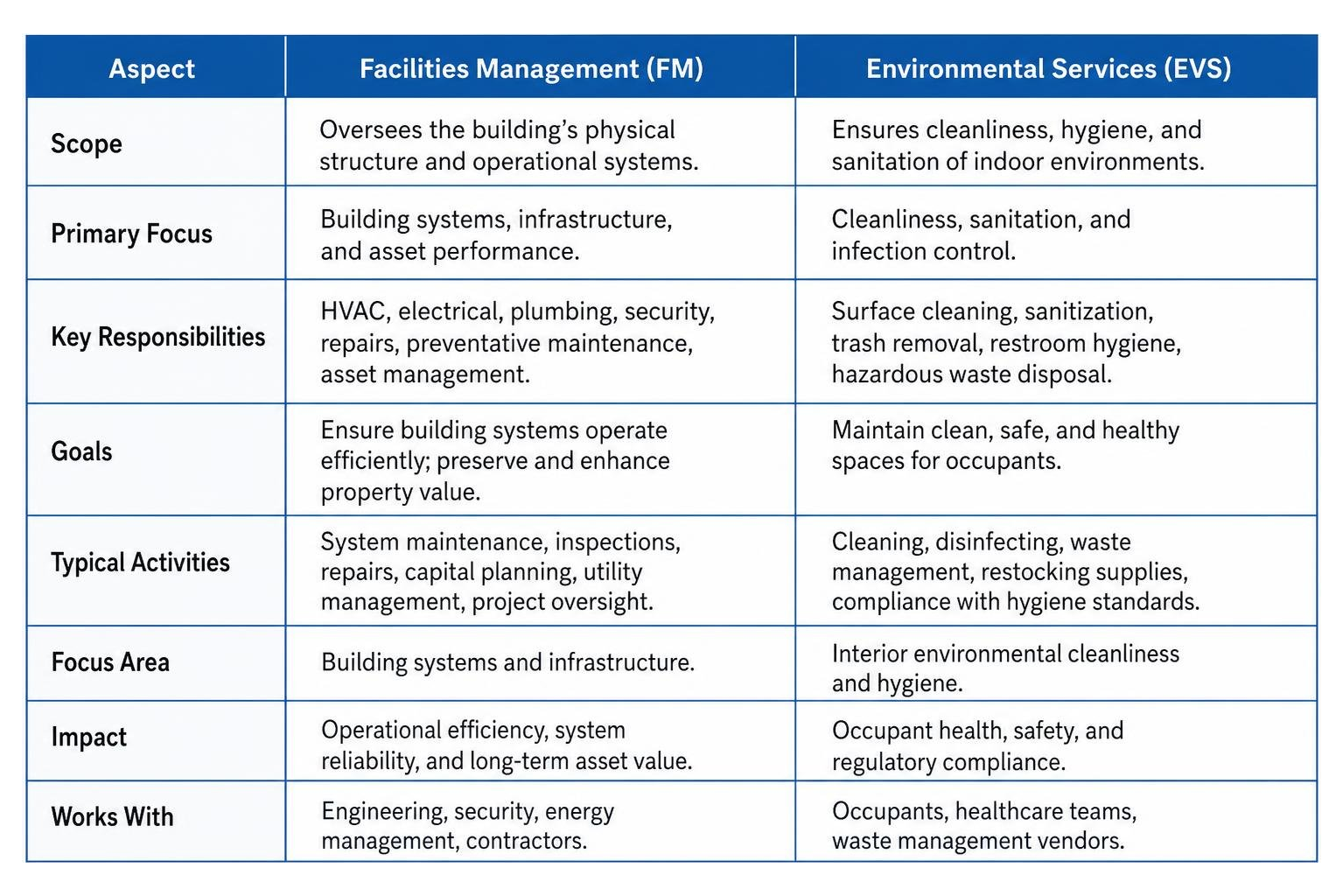
Facilities Management (FM) focuses on the overall physical structure and operational systems of a building. Its scope includes the organization and coordination of resources and services that support the physical structures, such as repairs, utility management, security, and general building maintenance. This division is responsible for the structural upkeep of the property, ensuring all building systems—HVAC, electrical, plumbing, and security—are functioning optimally. FM professionals manage assets, plan capital improvements, and oversee projects that preserve and enhance property value.
Environmental Services (EVS), often referred to as housekeeping or custodial services, are primarily concerned with the cleanliness, hygiene, and sanitation of the indoor environment. Their scope involves tasks such as surface sanitization, trash removal, restroom hygiene, and hazardous waste disposal. In specialized facilities like hospitals, EVS teams are crucial for infection control protocols and regulatory compliance related to medical waste. While FM ensures the building’s systems are operational, EVS ensures the spaces within are safe, clean, and healthy for occupants.
The distinction is critical for effective department coordination, especially in large facilities like hospitals or universities, where grounds maintenance, engineering, energy management, and environmental services must work in concert. For example, a facilities manager might oversee a tile restoration project, recognizing that deep renewal for hard surfaces can offer better-than-new durability at a fraction of the cost and downtime of full replacement. This strategic decision impacts the EVS team, who will then maintain the restored surfaces.
Here’s a comparison of their core responsibilities:
Training and Building Automation in Commercial Facility Maintenance and Environmental Control
In August 2026, the landscape of commercial facility maintenance is increasingly shaped by advanced technology and the need for a highly skilled workforce. Building automation systems (BAS) and continuous technical workforce training are paramount to maintaining building integrity, occupant safety, and operational efficiency.
Essential Training Topics for Facility Managers: Facility managers and their teams require continuous training across several critical areas to stay ahead of evolving technologies and regulations. Essential topics include:
- Structural Integrity Training: Covering structural assessments, roofing maintenance, and building systems integration to prevent deterioration and ensure long-term stability.
- Life Safety Training: Focusing on egress management, fire control systems, and emergency preparedness to protect occupants during unforeseen events.
- Environmental Control Training: Crucial for maintaining consistent indoor climates and air quality, this includes HVAC systems management, refrigeration maintenance, and condensation mitigation to prevent mold and structural damage.
- Utility Management Training: Encompassing electrical safety, water/wastewater management, and lighting systems maintenance to ensure efficient and safe utility operations.
- Building Automation Training: Equipping managers with the skills to operate and integrate BAS, understand direct digital controls (DDC), and leverage automation for optimal performance and cybersecurity.
The Role of Building Automation Systems (BAS): Modern BAS platforms, such as Metasys by Johnson Controls, Siemens’ Desigo, and Carrier Abound, are transforming environmental control. These systems integrate HVAC, lighting, security, and fire protection onto a single platform, offering unprecedented control and insight. For example, Metasys is designed to be constantly updated, preserving investment while adding functionality. It can support up to 1,300 IP devices and 65,000 objects per server, reducing infrastructure costs significantly. Siemens’ Desigo emphasizes an open platform ecosystem for scalable and customizable building automation, streamlining workflows by 33% through standardized tagging.
These systems improve environmental control by:
- Optimizing Energy Use: BAS can reduce energy consumption by up to 25% and improve system operational efficiency by 30% compared to traditional operations. Metasys, for instance, aligns with ASHRAE Guideline 36, which can save up to 30% on energy.
- Enhancing Indoor Air Quality (IAQ): By continuously monitoring and adjusting ventilation, temperature, and humidity, BAS ensures healthy and comfortable indoor environments.
- Predictive Capabilities: Integrating AI and IoT, systems like Carrier Abound provide predictive actionable insights, allowing facility teams to proactively manage buildings and diagnose issues remotely, reducing unplanned downtime by 45%.
Environmental Control Technology (ECT) Careers: The demand for professionals skilled in environmental control technology is growing. ECT programs train individuals for careers in HVAC, refrigeration, and building automation, focusing on hands-on experience with commercial hydronic systems, multi-vendor DDC, and energy efficiency. Graduates often become HVAC technicians, BAS technicians, energy efficiency specialists, and facilities managers, earning high salaries due to their specialized expertise. These roles are vital for implementing and maintaining the sophisticated systems that control indoor environments, making energy efficiency and occupant comfort a reality.
Predictive Maintenance, HVAC, and Commercial Facility Maintenance and Environmental Control
The paradigm shift from reactive to predictive maintenance is one of the most impactful advancements in commercial facility management. In the past, maintenance was often a response to equipment failure, leading to costly unplanned downtime and disgruntled occupants. Today, artificial intelligence (AI) and advanced analytics are enabling facilities to anticipate issues before they escalate.
Benefits of Predictive Maintenance: Facility teams that transition to predictive maintenance models experience significant improvements:
- Reduced Unplanned Downtime: A Deloitte 2022 study indicates a 37% reduction in unplanned downtime.
- Lower Energy Costs: BOMA benchmarks show a 20% reduction in energy costs.
- Decreased Maintenance Costs: McKinsey 2023 reports a 25% lower overall maintenance cost.
- Substantial Savings: For a mid-size commercial building portfolio, shifting to predictive maintenance translates to roughly $150,000 to $600,000 in annual savings from avoided equipment failures, reduced energy waste, and fewer tenant complaints.
How AI and Predictive Maintenance Work: AI-powered systems continuously monitor critical assets like HVAC, electrical, and plumbing systems. They analyze data from sensors, building automation systems, and historical performance to identify anomalies and predict potential failures. For example, if a tenant calls about the AC, an AI-driven system might have already flagged a potential issue with the rooftop unit or chiller, allowing the facility team to address it proactively. Digital monitoring can improve energy savings by 25%, reduce occupant complaints by 60%, improve system operational efficiency by 30%, and reduce system downtime by 45% compared to traditional operations.
HVAC failures and missed preventive maintenance (PM) schedules are particularly costly, running $2-5 per square foot annually for buildings. Predictive maintenance leverages continuous BMS monitoring, electrical load tracking, and plumbing checks to prevent these issues. AI copilots can prioritize work orders based on tenant impact and equipment criticality, ensuring that urgent issues are addressed promptly while routine PM tasks remain on schedule.
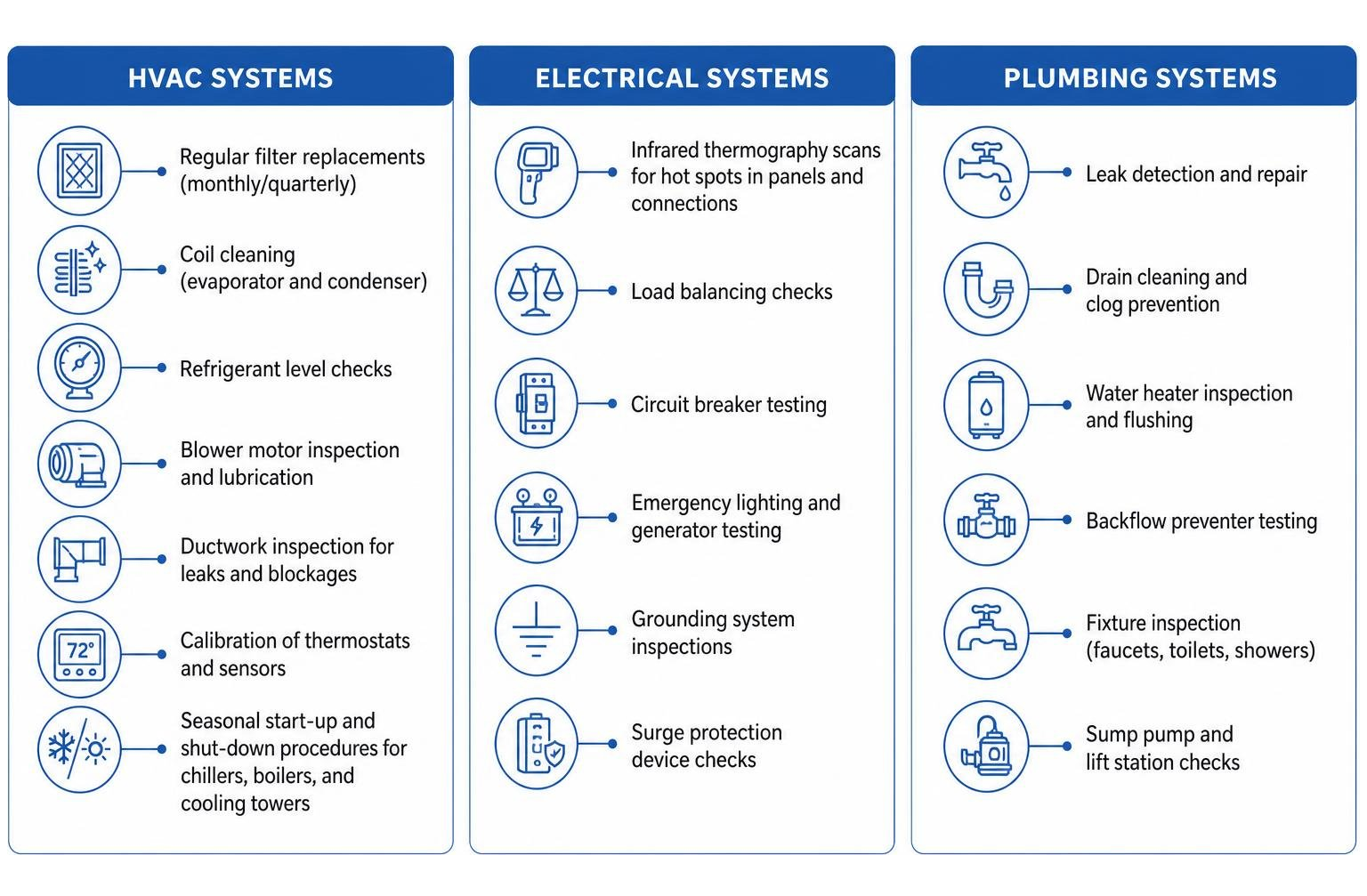
Essential Preventive Maintenance Tasks: A robust preventive maintenance schedule for HVAC, electrical, and plumbing systems is foundational to facility integrity:
- HVAC Systems:Regular filter replacements (monthly/quarterly)
- Coil cleaning (evaporator and condenser)
- Refrigerant level checks
- Blower motor inspection and lubrication
- Ductwork inspection for leaks and blockages
- Calibration of thermostats and sensors
- Seasonal start-up and shut-down procedures for chillers, boilers, and cooling towers
- Electrical Systems:Infrared thermography scans for hot spots in panels and connections
- Load balancing checks
- Circuit breaker testing
- Emergency lighting and generator testing
- Grounding system inspections
- Surge protection device checks
- Plumbing Systems:Leak detection and repair
- Drain cleaning and clog prevention
- Water heater inspection and flushing
- Backflow preventer testing
- Fixture inspection (faucets, toilets, showers)
- Sump pump and lift station checks
By implementing these tasks with the aid of predictive analytics, facility managers can optimize asset health scoring, significantly reduce operational costs, and enhance occupant comfort.
Advancing Building Efficiency, Regulatory Compliance, and System Integration
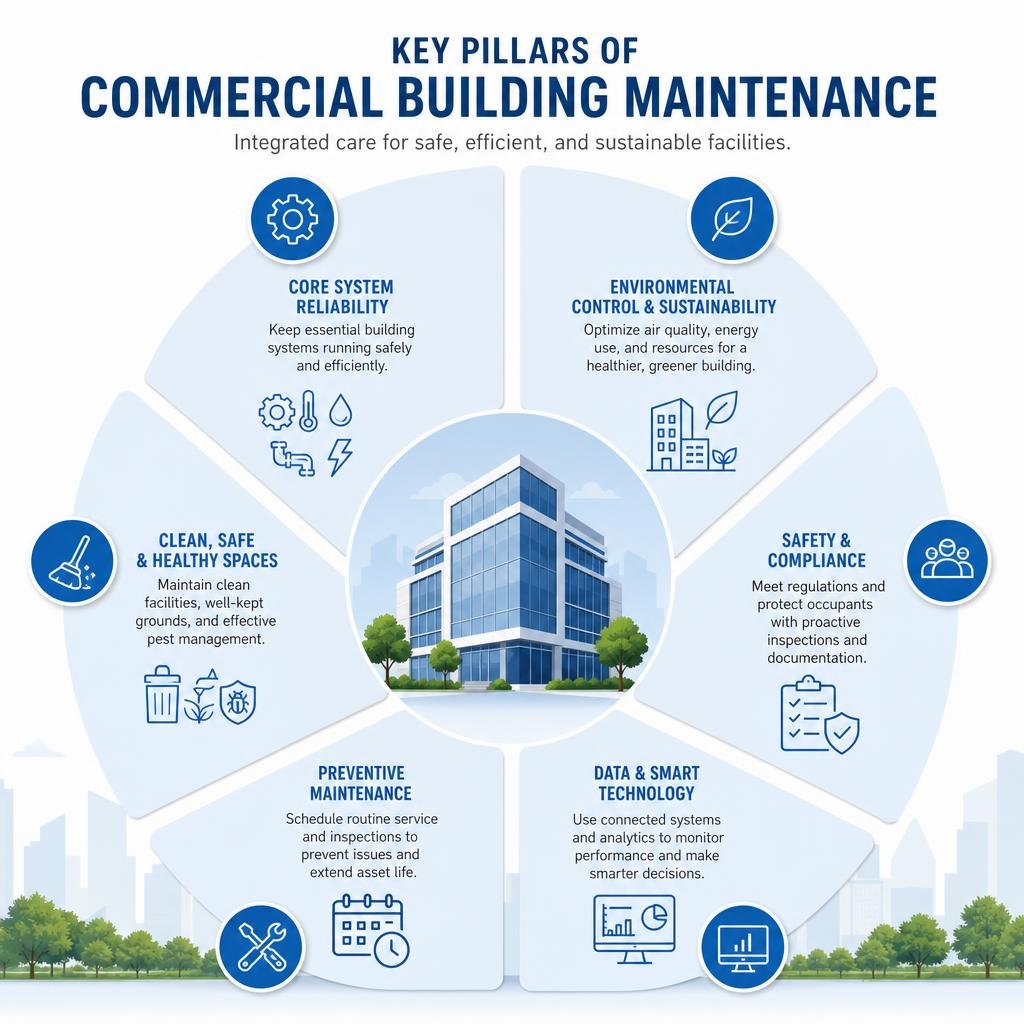
Achieving optimal building efficiency and ensuring regulatory compliance in commercial facilities requires a holistic approach that integrates various services and leverages advanced technologies. This involves not only internal maintenance but also external services and robust system integration.
Complementary Services: Grounds, Sanitation, and Pest Management
While internal facility management focuses on the building’s core systems, external services play a vital role in presenting a professional image, ensuring occupant safety, and maintaining environmental standards. Commercial cleaning, grounds maintenance, and pest management services are crucial complements to facility management.
Commercial Cleaning and Grounds Maintenance: Consistent cleaning and well-maintained grounds contribute significantly to a commercial facility’s appeal and hygiene. Services range from daily commercial cleaning to specialized restoration and deep cleaning. Quality control reporting and electronic request tracking ensure accountability and consistent service quality. For instance, quarterly customer satisfaction surveys and electronic communication tracking help maintain high standards. A pristine exterior, including landscaping and parking areas, creates a positive first impression and prevents issues like water damage from overgrown vegetation. For comprehensive upkeep, many facilities rely on expert providers for their commercial property maintenance needs, ensuring everything from landscaping to exterior sanitation is handled professionally.

Pest Management: Pest mitigation is another essential, often overlooked, aspect of facility maintenance and environmental control. Infestations can compromise structural integrity, damage inventory, and pose significant health risks to occupants. Integrated pest management (IPM) strategies, which combine prevention, monitoring, and targeted treatments, are crucial for commercial spaces. Regular inspections and proactive measures help keep facilities pest-free, safeguarding health and preventing costly damage. Partnering with specialists in commercial pest control ensures effective and compliant pest management strategies are in place.
These complementary services, when integrated with core facility management, create a seamless operational environment that upholds both aesthetic standards and critical health and safety protocols.
Regulatory Compliance, Sustainability, and Unified Operations
In today’s regulatory landscape, facility managers face increasing pressure to ensure compliance with environmental regulations and achieve ambitious sustainability goals. This requires a sophisticated approach to system integration and operational synergy.
Ensuring Compliance and Sustainability: Compliance is multifaceted, encompassing everything from energy performance standards like ASHRAE Guideline 36 to stringent cybersecurity requirements and environmental emissions monitoring. Building automation systems (BAS) are pivotal here. Metasys, for example, is designed with IEC 62443-4-2 alignment for cybersecurity and supports zero trust architecture, crucial for protecting sensitive building data. Similarly, platforms like Desigo emphasize open platform ecosystems that adapt to evolving energy and carbon regulations, helping facilities meet decarbonization goals.
Sustainability initiatives often involve reducing energy consumption, improving indoor air quality, and minimizing waste. Facilities can leverage advanced environmental control technologies to monitor and manage factors like air quality, temperature, and humidity, ensuring optimal conditions while reducing their carbon footprint. For facilities with industrial processes, specialized equipment for managing airborne contaminants and emissions is critical. These systems, often referred to as industrial air pollution controls, are essential for meeting strict environmental standards and protecting both internal and external environments.
Unified Facility Operating Systems: The complexity of modern facilities often leads to fragmented operations, with different departments using disparate software tools for maintenance, environmental services, and food service. However, integrating these functions into a unified facility operating system (FOS) offers significant benefits:
- Operational Synergy: A unified platform, such as FacOps™, connects CMMS, EVS, and food service operations. This integration creates a “Golden Thread” of data continuity, where an event in one department automatically triggers actions in others. For instance, a walk-in cooler failure could automatically generate a CMMS work order, alert EVS for spoilage cleanup, and notify dietary staff to adjust meal preparation.
- Enhanced Efficiency: By centralizing data and workflows, these systems streamline operations, reduce manual tasks, and improve communication across departments. This can lead to significant cost reductions—FacOps claims up to 40% operational cost reduction and estimated annual savings of $235,000 for a 100,000 sq ft facility.
- Improved Compliance: Integrated systems facilitate easier tracking and reporting for regulatory compliance, such as HACCP for food safety or infection control protocols in healthcare settings. IoT temperature monitoring, for example, can automate HACCP logging for refrigeration equipment.
- Predictive Capabilities: Combining BAS and IoT integration with AI-powered analytics allows for predictive maintenance, proactive issue resolution, and optimized resource allocation. Tools like AI document intelligence and smart glasses copilots further enhance field team efficiency by providing real-time information and conversational troubleshooting.
By embracing these integrated, technology-driven approaches, facility managers can ensure their commercial properties are not only safe and compliant but also highly efficient and sustainable for years to come.
 ©2026 The Dedicated House. All rights reserved. No part of this blog post may be used or reproduced without the written consent of the copyright owner.
Click the links below for any posts you have missed:
 How to Assess and Address Emergency Roof Damage in a Storm
 Understanding the Benefits of Quality Gardening Equipment
 How Different Types of Materials are Sourced for Construction
 Simple Upgrades that Boost Your Home Sale Value
 How Music Can Help Ease Anxiety for Young Students at Home
 The Healthier Home Materials Checklist
I’d love for you to join my email list! You’ll receive a notification straight to your inbox which will include links to my latest home project posts! Simply enter your address below.
Thanks for stopping by! Have a wonderful day/night depending on where you are in the world! Go with God and remember to be kind to one another!
Toodles,

Leave a Reply