Most people get their pool ready for summer by looking at the water. They shock it, scrub the tiles, top up the level and call it done. The water is the easy part. The things that actually ruin a summer, a pump that dies on the first hot weekend, a filter that cannot keep up, a power bill that doubles in January, all live on the equipment pad behind the fence, and nobody looks at it until something stops. This is the check worth doing before summer, in the order that saves the most money.
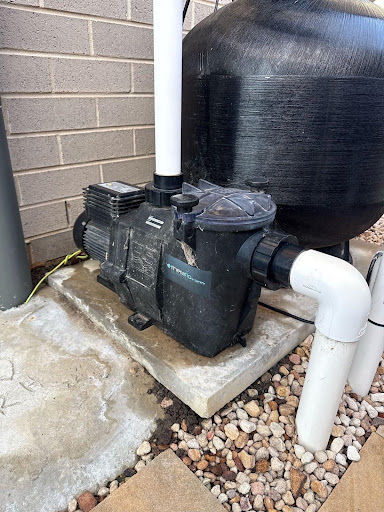
Before: an older single speed pool pump on its concrete pad beside the filter.
1. Listen to the Pump Before You Look at It
Turn the pump on and stand next to it for a minute. A healthy pump hums. A screech or a grinding note usually means the motor bearings are going, and once that starts the pump has months left, not years. A gurgle or a rattle in the pump basket means it is sucking air, which is normally a cracked lid, a perished lid o ring or a loose fitting on the suction side. Air leaks are cheap to fix and worth fixing early, because a pump that runs dry for long enough cooks its seal.
2. Check for Water Where There Should Not Be Any
Look under the pump for a damp patch or a white crust. A slow drip from the join between the motor and the wet end is the shaft seal, and if it is ignored the water eventually finds its way into the motor. A seal replacement is a small job on a newer pump. On a pump that is ten years old and already noisy, it is usually money spent on something that will fail another way within a season.
3. Read the Filter Pressure Gauge
Note the pressure on the filter gauge right after a backwash or a cartridge clean. That is your clean reading. When the needle climbs about 50 kPa (roughly 8 psi) above it, the filter needs attention. If the gauge is stuck, fogged or missing, replace it; they are inexpensive and without one you are guessing. A filter that is always dirty makes the pump work harder for less flow, which costs power every hour it runs.
4. Check the Salt Cell
If you have a salt water chlorinator, pull the cell out and look at the plates. A white, chalky build-up is calcium scale, and a scaled cell makes less chlorine while drawing the same power. Clean it the way the manufacturer says, and check the salt level while you are there.
5. Look at the Timer
Find out how long the pump is set to run and when. In a lot of houses the timer was set by the builder years ago and never touched, which often means eight or ten hours a day in winter as well as summer. Even before changing any equipment, matching the run time to the season and the pool size is the cheapest saving on the pad.
6. Work Out What the Pump Actually Costs You
This is the step that changed my mind about the whole setup. An older single speed pump has one speed, flat out, whether it is running a backwash or just turning the water over. A typical single speed pump draws about 1 kilowatt. Run it eight hours a day and that is about 8 kilowatt hours a day, or close to $1,000 a year at around 35 cents a kilowatt hour. Australia’s Energy Rating program puts the pool pump at nearly 18 per cent of the electricity used in an average home with a pool.
A variable speed pump does the same job very differently. It runs slowly for most of the day and only speeds up for cleaning or a backwash. Because the power a pump draws falls away steeply as it slows, running at half speed uses roughly an eighth of the power. The Energy Rating program puts the gap between an 8 star pump and a 2 star pump at more than $540 a year. It is also dramatically quieter, which you notice the first night it runs.
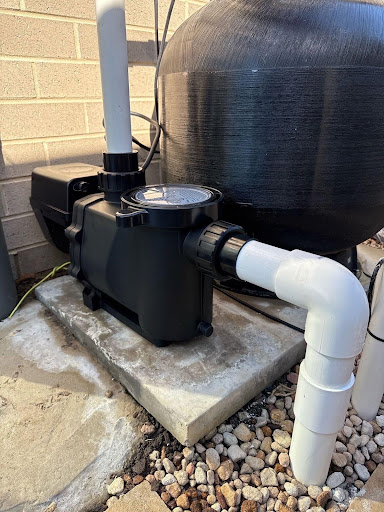
After: the new variable speed pool pump installed and plumbed in on the same pad. Photos: Efficient Energy Group.
The Upgrade that Paid for Itself
The reason most people put off a pump upgrade is the price. A quality variable speed pump supplied and installed by a pool shop usually comes in at $1,400 to $1,600. What most New South Wales pool owners do not know is that the state’s Energy Savings Scheme covers a large part of that cost when an old pump is swapped for an efficient new one. The discount comes straight off the installed price rather than arriving later as a refund, and there is nothing to apply for. Through the scheme, a pool pump replacement in Sydney with a new 6 star variable speed pump currently comes to $899 installed, including removal of the old pump and programming for the pool and filter.
The new pump has to be at least 4 stars on the national energy rating register and the old one has to be removed, which is why the work goes through the scheme rather than a shelf at the pool shop. Eligibility is checked before anyone comes out, usually from a few photos of the existing pump, and most swaps take under an hour and plug into the existing power point. A pump that has already died can be replaced the same way. The steps and current pricing are set out on Efficient Energy Group’s pool pump page.
Do Not Skip the Programming
A variable speed pump that is left running flat out saves nothing. The saving comes entirely from the schedule: long, slow circulation for most of the day, a short faster run to work the skimmer and the filter, and a higher speed for backwashing or a pool cleaner if you have one. Whoever installs it should set that schedule for your pool, show you how it works and leave it running before they go. If they do not, ask.
The Short Version
Listen to the pump, look for leaks, take a clean filter reading, check the salt cell and the timer, and work out what the pump costs to run. If the pump is more than eight years old, loud enough to hear from inside and your summer power bills jump for no other reason, the replacement is the best value job on the whole equipment pad. Do it before the first heatwave, and the first summer’s saving does most of the paying.
©2026 The Dedicated House. All rights reserved. No part of this blog post may be used or reproduced without the written consent of the copyright owner.
Click the links below for any posts you have missed:
 A Moving-Out Checklist Before a Knockdown Rebuild Begins
 Modern Luxury Kitchen & Dining Room Ideas: Creating an Elegant Home
 What to Know Before Replacing Worn Dishwasher Rack Parts
 Best Bed Frame for Kids: Top Picks for Your Kids in 2027
 The Construction Payment Bottleneck: How Delays Affect Home Projects
 The Overlooked Role of Backflow Prevention in Commercial Property Risk Management
I’d love for you to join my email list! You’ll receive a notification straight to your inbox which will include links to my latest home project posts! Simply enter your address below.
Thanks for stopping by! Have a wonderful day/night depending on where you are in the world! Go with God and remember to be kind to one another!
Toodles,

Leave a Reply